
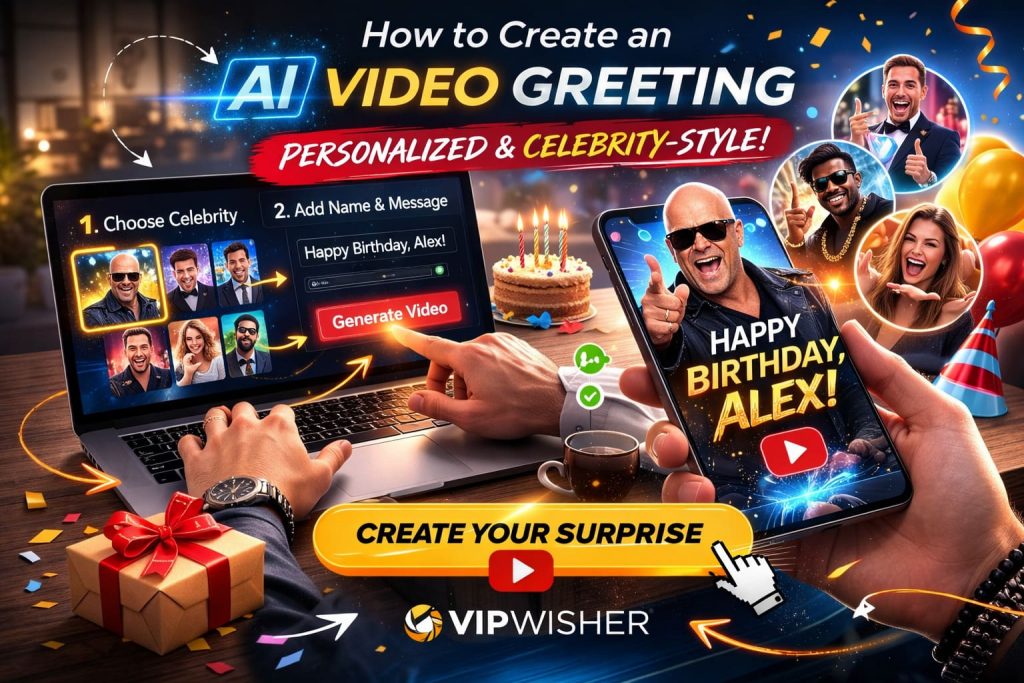
Creating an AI video greeting is easy.
Creating one that feels personal, funny, and actually worth sending is harder.
That is the difference most people run into. The tool itself is not usually the problem. The real challenge is making the final video feel like it was made for one specific person, not generated from a bland template.
If you are wondering how to create an AI video greeting for a birthday, anniversary, celebration, inside joke, or surprise gift, this guide walks through the process in a practical way. It focuses on what actually makes the result better, not just how to click through a form.
If you want to see ready-to-use celebrity-style options first, you can browse them here: VipWisher AI stars.
Start With the Occasion, Not the Tool
Most weak AI greetings start the same way: someone picks a style first and only later thinks about what the message is supposed to do.
That usually leads to generic output.
A better approach is to start with the situation:
- Is this for a birthday?
- Is it supposed to be funny or warm?
- Is it a one-to-one private message or something for the group chat?
- Is the goal to make someone laugh, feel appreciated, or feel surprised?
Once that is clear, the rest gets much easier.
For example, a birthday greeting for a best friend should not sound like a retirement message. A playful gift for a boyfriend should not sound like a corporate congratulations video. The occasion should shape the message before you choose tone, character, or style.
Decide What Reaction You Want
Before writing anything, ask one useful question:
What should the person do right after watching the video?
Usually the answer is one of these:
- laugh immediately
- feel touched
- replay it
- send it to friends
- feel proud
- feel surprised
This matters because AI video greetings work best when they are built around one clear emotional outcome.
If you try to make the same message funny, heartfelt, romantic, dramatic, and inspirational all at once, it usually ends up sounding generic.
Pick a Style That Matches the Person
This is where a lot of people make the wrong choice.
They pick the style they personally like, instead of the style that fits the recipient.
The right AI video greeting style depends on the person receiving it:
- funny and chaotic for a loud best friend
- warm and thoughtful for a parent or close friend
- smooth and playful for a flirty relationship gift
- motivational for a graduation or work milestone
- bold and exaggerated for a joke-heavy group surprise
That is why style should always come after occasion and reaction.
If you already know the kind of tone you want, you can explore celebrity-style options on VipWisher.
Gather the Details That Actually Matter
You do not need a full script. You need the right ingredients.
A good AI greeting usually becomes more personal from a few small details, not from a huge amount of text.
The most useful details are:
- the recipient’s first name
- the occasion
- your relationship to them
- one inside joke
- one personality trait
- one specific detail about their life right now
- the tone you want
Here is a simple example of useful input:
- Name: Alex
- Occasion: 30th birthday
- Relationship: best friend
- Personality: loud, funny, always late
- Tone: playful and teasing
- Detail: obsessed with the gym and fantasy football
That is much better than writing something vague like:
“Make a fun birthday video for my friend.”
Specificity gives AI something to work with.
Write for Spoken Video, Not for a Greeting Card
This is one of the biggest mistakes people make.
An AI video greeting is not a greeting card and not an email. It should sound like something a person would actually say out loud.
That means the message should be:
- short enough to stay punchy
- conversational
- easy to understand in one listen
- built around rhythm, not long paragraphs
Bad example:
Wishing you all the very best on this special occasion and hoping the coming year brings health, happiness, and prosperity.
That sounds like filler.
Better example:
Alex, you made it to 30. Honestly, this deserves more than a lazy text, and you know it.
That sounds like a video.
Use One Strong Angle Instead of Five Weak Ones
The best AI greetings usually have one clear identity.
Good angles include:
- “better than a boring birthday text”
- “this gift had to match your personality”
- “you earned more than a basic congratulations”
- “this belongs in the group chat”
- “I wanted to send something you would actually remember”
That angle should shape the whole message.
When people try to force too many ideas into one greeting, it starts to sound like a stitched-together prompt instead of a real message.
Keep the Message Shorter Than You Think
A common mistake is making the greeting too long.
In most cases, a short video with one good joke, one personal detail, and one clean ending works better than a long message that tries to do too much.
A strong structure is:
- Get attention quickly
- Mention the person by name
- Add one or two personal details
- Land the main joke, compliment, or message
- End clearly
That is enough.
People are much more likely to replay and share a short, sharp greeting than a long one.
Make It Personal Without Making It Complicated
People often assume “personalized” means “I need to write a detailed script.”
Not true.
Usually, the greeting feels personal because it includes:
- the right name
- the right relationship
- the right tone
- the right reference
That is all.
You do not need to explain the person’s whole life story. You only need enough detail to make the message feel clearly meant for them.
That is one reason platforms like VipWisher work well for this format: the greeting text can be generated automatically from a short form, which removes a lot of the writing friction.
Think About Where the Video Will Be Sent
This changes the best style more than people expect.
If the greeting is for:
- a private DM, it can be more personal
- a group chat, it should be faster and more shareable
- a birthday dinner, it should hit quickly
- a couple gift, it can feel more affectionate
- a work setting, it should stay cleaner and less risky
The delivery context matters because a message that works perfectly in private may feel awkward if played in front of ten people.
Mistakes to Avoid
A lot of AI greetings miss because of a few predictable problems.
1. Making it too generic
If the message could be sent to anyone, it will feel forgettable.
2. Adding too many ideas
One clear angle works better than five disconnected ones.
3. Writing like a card
Video should sound spoken, not formal.
4. Choosing the wrong tone
A roast-style message for the wrong person can fail fast.
5. Making it too long
Shorter usually performs better.
6. Forgetting the person’s actual personality
The best style is not the “coolest” one. It is the one that fits the recipient.
A Simple Formula That Works
If you want a simple formula, use this:
Name + occasion + personality detail + one memorable angle + clean ending
Example:
“Jordan, happy birthday. A normal text would have been way too boring for someone this chaotic, so obviously this had to be bigger. Enjoy the day, enjoy the attention, and try not to act surprised that people actually planned something good for once.”
That sounds specific. It sounds spoken. And it sounds like it belongs to one person.
When an AI Video Greeting Works Best
This format is especially strong when:
- the recipient already “has everything”
- you want something more memorable than a gift card
- you need a funny or personal surprise
- the occasion is social and shareable
- you want to send something quickly without making it feel lazy
It can work for birthdays, anniversaries, graduations, promotions, retirements, group jokes, and best-friend surprises.
If your use case is mostly birthday-focused, read AI Birthday Video Message.
If you want to understand the format itself, read Celebrity-Style Video Greeting.
The Easiest Way to Create One
In practical terms, the workflow is simple:
- Choose the occasion
- Decide the tone
- Pick the style that fits the recipient
- Add a few useful personal details
- Review the generated message
- Order or generate the final video
That is the easiest path because it keeps the process focused on outcome, not on writing a perfect script from scratch.
If you want to try it directly, you can start here: https://vipwisher.com?ref=28
FAQ
How do I create an AI video greeting that does not feel generic?
Use real details: the person’s name, the occasion, one personality trait, one inside joke, and a clear tone. Generic input creates generic output.
Do I need to write the whole greeting myself?
No. In most cases, you only need to provide the right details and direction. The full message can then be generated from that input.
What is the best occasion for an AI video greeting?
Birthdays are one of the strongest use cases, but it also works well for anniversaries, graduations, congratulations, and funny personal surprises.
Should the message be funny or heartfelt?
Pick one main direction. Funny usually works better for group sharing. Heartfelt usually works better for close personal relationships.
How long should an AI video greeting be?
Shorter is usually better. A message that gets to the point quickly is more memorable and more shareable.
If you want to create an AI video greeting that actually feels personal, the real trick is simple: stop trying to write a perfect speech, and start building a message around one real person, one real occasion, and one clear reaction. That is what turns a generated video into a gift people actually remember.